Ag Exemption Texas: Complete 2026 Guide to Agricultural Valuation
Complete 2026 guide to Texas agricultural valuation. Learn how productivity value is calculated, what counts as qualifying agricultural use, and how to keep your ag exemption once approved.
The Texas agricultural exemption, formally called the 1-d-1 open-space land valuation, values your land based on what it can produce rather than what it could sell for on the open market. For most landowners, this reduces the taxable value by 70 to 90 percent compared to market value. The savings are not a one-time benefit: once approved, the valuation continues every year as long as you maintain qualifying agricultural use.
This guide covers what every Texas landowner needs to know in 2026: how productivity value is actually calculated, which uses qualify, what triggers a rollback penalty, and how to stay in compliance once you have the exemption.
How Does Agricultural Valuation Work in Texas?
Market value is what a willing buyer would pay a willing seller. Productivity value is what the land can earn through agricultural production. The difference between the two is what the ag exemption protects you from paying taxes on.
Texas uses an income capitalization approach to determine productivity value. The formula looks at the net income a typical agricultural operation would generate from the land, then divides that by a capitalization rate to arrive at a value. The appraisal district does not calculate this individually for your property. They use standardized productivity values based on the land's agricultural use category and soil classification.
The Productivity Value Formula
The Texas Comptroller requires all 254 county appraisal districts to use a uniform method. The formula works like this:
Gross cash receipts from the agricultural product (cattle sales, hay value, crop yields) minus production costs (feed, fertilizer, fuel, labor, repairs) equals net income per acre. The net income is then divided by a capitalization rate to convert annual income into a land value. Tax Code 23.53 sets a floor on that rate: the chief appraiser may not use a rate lower than 10 percent.
A pasture with a net income of $15 per acre, divided by a 10 percent capitalization rate, produces a productivity value of $150 per acre. If that same acre would sell for $5,000 on the open market, the ag exemption saves you tax on $4,850 of value per acre. Across 50 acres, that is a $242,500 reduction in taxable value.
INFO
Productivity values vary by county and by agricultural use. Hay production land in East Texas may support a higher productivity value than native pasture in West Texas, but the savings relative to market value remain substantial regardless of location.
What Counts as Qualifying Agricultural Use?
The Texas Tax Code recognizes several categories of agricultural use. Your land must be devoted principally to one of these uses to qualify.
Livestock Production
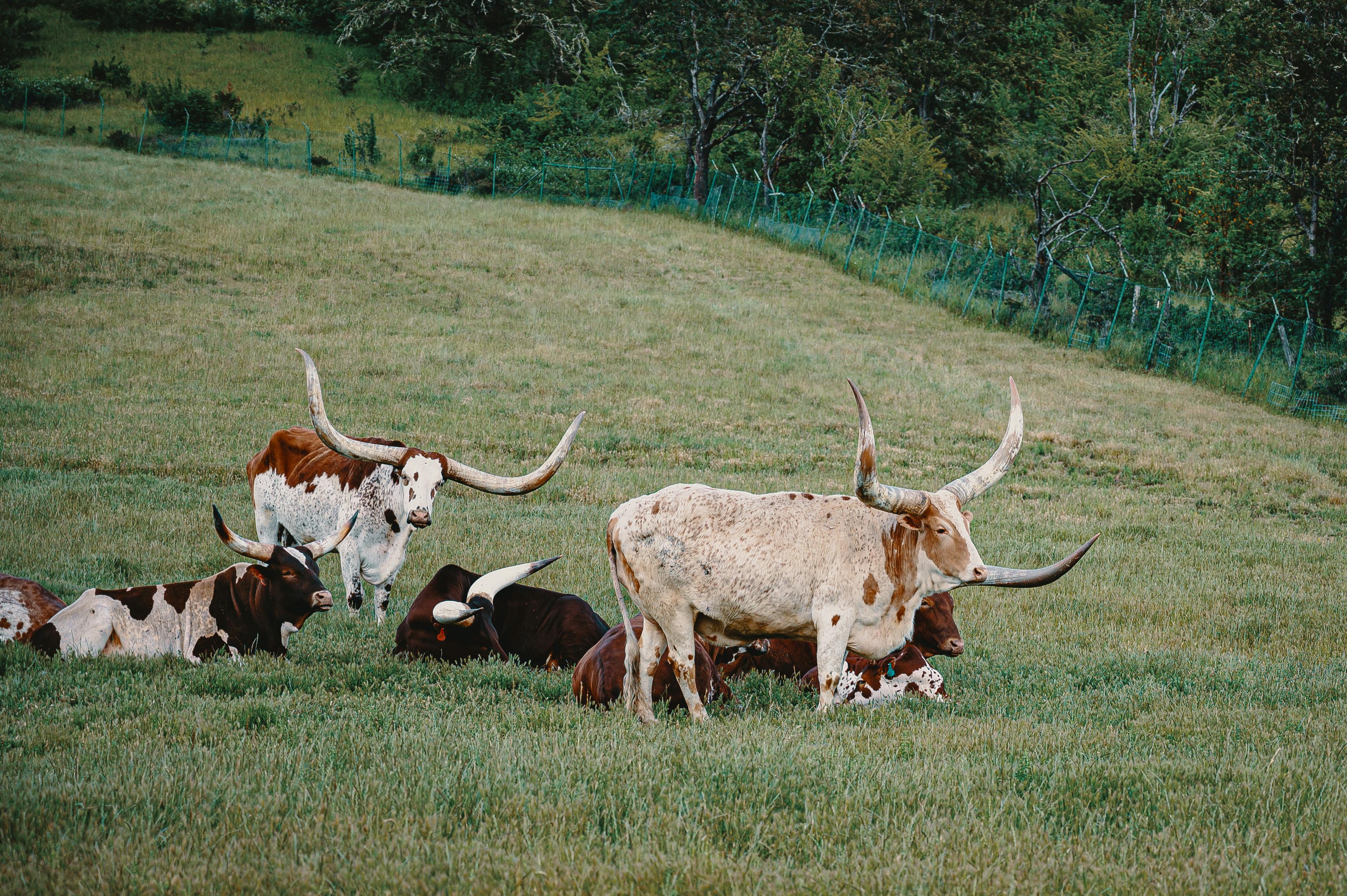
Cattle, goats, sheep, and horses used for ranch work or breeding are the most common qualifying livestock. Exotic livestock like bison, elk, and ostriches also qualify if they are raised for commercial production. The key requirement is that the operation runs at the intensity level standard for your county.
Your county appraisal district expects to see evidence of a real commercial operation: stocking rates appropriate for your acreage, documentation of sales, veterinary records, and fencing and water infrastructure consistent with the livestock you claim. Hobby animals on a few acres generally do not qualify.
For a full list of qualifying animals and what each requires, see our guide on what animals qualify for the Texas ag exemption.
Hay Production and Crop Farming
Hay production is popular because it works on a wide range of acreages and does not require the same infrastructure investment as livestock. Coastal Bermuda and Tifton 85 are common in Texas, and the appraisal district expects evidence of actual harvest: bale counts, sales receipts, photos of equipment and stored hay.
Row crops like cotton, corn, sorghum, and wheat qualify if the acreage is sufficient for a commercial operation. Orchards and vineyards also qualify, but the timing requirements differ. Most fruit and nut trees do not produce for several years, and the appraisal district expects a managed operation with a timeline to commercial production.
Timber Production
Timber land qualifies under a separate statute but follows the same principle: the land is valued based on timber productivity rather than market value. You need a timber management plan, evidence of harvest or planned harvest, and compliance with Texas A&M Forest Service best management practices. See our complete timber exemption guide for application requirements and qualifying acreage.
Beekeeping
Beekeeping qualifies as agricultural use in Texas, but only on tracts of not less than 5 and not more than 20 acres. That band comes straight from Tax Code 23.51(2), so land above 20 acres cannot qualify on beekeeping alone. The typical county requirement is 6 hives for the first 5 acres and roughly 1 additional hive per 2.5 additional acres beyond that, though county standards vary. You need documented honey production or pollination services, and your hives must be actively managed. For the full requirements, see our beekeeping exemption guide.
Wildlife Management
If your land already has ag valuation and you want to shift from traditional agriculture to wildlife management, you can convert the valuation without losing it. Wildlife management requires a written management plan targeting at least three of seven qualifying activities: habitat control, erosion control, predator control, supplemental water, supplemental food, supplemental shelter, and census counts. The conversion preserves the same productivity valuation you had under agricultural use.
Our guide on switching from ag exemption to wildlife management walks through the entire conversion process, including the plan requirements and annual reporting.
How to Keep Your Ag Exemption Once Approved
Once your land receives the 1-d-1 valuation, you must maintain qualifying agricultural use every year. The appraisal district does not automatically remove you, but they can audit you at any time. A lapse in use, a change in ownership that breaks the qualifying use, or a failure to maintain the required intensity level can trigger a rollback penalty.
Annual Requirements
Your agricultural operation must continue at the intensity level typical for your county. If you had 20 cows on 50 acres when you qualified and you drop to 5 cows without a documented reason, the appraisal district may determine that you are no longer at the intensity standard.
Keep records of everything: livestock purchases and sales, hay bale counts, fertilizer receipts, equipment maintenance logs, and photos of the operation. If the appraisal district questions your use, these records prove that your operation is legitimate and ongoing.
What Triggers a Rollback Penalty
If you stop using your land for agriculture, or if the use drops below the county's intensity standard, the appraisal district can remove your ag valuation and trigger a rollback penalty. The rollback covers the three years preceding the year the use changed, and the change-of-use year itself is not included. You owe the difference between the taxes you paid under ag valuation and what you would have paid under market valuation for each of those three years. There is no interest on the penalty. HB 1743, effective September 1, 2019, cut the lookback from five years to three, and HB 3833, effective June 15, 2021, deleted the interest charge entirely.
Our rollback penalty guide explains exactly how the penalty is calculated, what actions trigger it, and how to avoid it.
Change in Ownership
The ag valuation does not automatically transfer to a new owner. If you buy land that already has ag valuation, you must apply for the 1-d-1 valuation in your own name by April 30 following the purchase. The previous owner's qualifying use history transfers to you, meaning you do not need to start from zero establishing the 5-of-7-year history requirement. But you still must file the application.
If you are selling land with ag valuation, the buyer should confirm that they intend to continue agricultural use and file the application on time. If they do not, the rollback penalty becomes the seller's responsibility.
How to Apply for Agricultural Valuation
The application process uses Form 1-D-1, the Application for 1-d-1 (Open-Space) Agricultural Use Appraisal. You file it with your county appraisal district by April 30 of the tax year. The form asks for:
- The agricultural use you are claiming (livestock, hay, crops, timber, bees, etc.)
- The acreage devoted to each use
- How long the land has been in agricultural use
- Supporting documentation of your operation
Our step-by-step application guide walks through each section of the form and what documentation to provide for each type of agricultural use.
WARNING
Do not file Form 1-D-1 on land that clearly does not qualify. A premature or poorly documented application can create a record with the appraisal district that makes future applications harder. If you are unsure whether your land qualifies, review the requirements first and gather your documentation before submitting.
What Acreage Do You Need for an Ag Exemption?
Texas does not set a statewide minimum acreage. Each county appraisal district sets its own intensity standards based on the typical agricultural operations in that county. In rural West Texas, 20 acres of native pasture with cattle may meet the standard. In a suburban county near Dallas, the same 20 acres may need a more intensive use like hay production to satisfy the district's expectations.
Our county-by-county acreage guide shows the typical minimums and intensity expectations for counties across Texas. Before you apply, look up your county's standards so you know what to document.
How Much Does the Ag Exemption Actually Save You?
The savings depend on three factors: the difference between market value and productivity value, your county's tax rates, and the acreage you have under ag valuation. Here is how to estimate your savings.
Example: 50 Acres of Pasture in a Suburban County
Assume 50 acres of pasture land appraised at $8,000 per acre market value. Total market value: $400,000. The ag valuation assigns a productivity value of $200 per acre based on cattle grazing. Total productivity value: $10,000. The exemption removes $390,000 from the taxable value.
If the combined tax rate for the county, school district, and other taxing units is 1.8 percent, the annual savings work out to roughly $7,000 per year compared to paying full market value taxes.
Example: 200 Acres in a Rural County
In a rural county with lower market values and tax rates, the math still works. At $2,500 per acre market value, 200 acres total $500,000. A productivity value of $75 per acre for native pasture brings the taxable value down to $15,000. The exemption removes $485,000 from taxation. At a 1.2 percent combined rate, the annual savings are just under $6,000.
The Compounding Effect
These savings repeat every year. Over a 10-year ownership period, a landowner saving $7,000 annually accumulates $70,000 in tax savings. The savings also make the property more attractive to buyers since the ag valuation can transfer to a new owner who continues the agricultural use.
Use our property tax savings estimator to plug in your county's rates and acreage for a personalized estimate.
Where to Go Next
The ag exemption is the single most valuable property tax tool for Texas landowners with qualifying acreage. The application is free, and the savings compound year after year. The key is getting your documentation right before you file and maintaining your operation at the county's intensity standard after you are approved.
If you are evaluating which exemption strategy fits your property best, compare the ag exemption versus conservation easements to understand the tradeoffs between annual tax savings and permanent tax deductions.
For a complete picture of all available tax relief strategies, visit our property tax exemptions hub.
NOTE
The bottom line: agricultural valuation values your land by what it produces, not what it sells for. Apply by April 30 with documentation of qualifying use. Once approved, maintain your operation at the county's intensity standard, keep records, and the savings continue every year you own the property.
Sources
This reflects Texas law as of August 2026, including HB 1743 (86th Legislature, effective September 1, 2019), which cut the open-space rollback from five years to three, and HB 3833 (87th Legislature, effective June 15, 2021), which removed rollback interest.
- Texas Tax Code Section 23.51 - qualified open-space land, including the 5 to 20 acre beekeeping band
- Texas Tax Code Section 23.53 - capitalization rate, floor of 10 percent
- Texas Tax Code Section 23.55 - additional tax on change of use
- HB 1743 (86th Legislature) and HB 3833 (87th Legislature)
- Manual for the Appraisal of Agricultural Land - the Comptroller's prescribed methodology
- Form 50-129 - the 1-d-1 open-space application
Verified August 6, 2026. Productivity values and intensity standards are set by each chief appraiser from local data, so the dollar figures in the examples above are illustrative, not your county's actual schedule.